Portfolio
Statement
Structures are useful. They help us to parse complex information into easily understood patterns. We use structure to comprehend infinities: Material structure defines the space we live in — country, city, house, bedroom, kitchen etc. — in an infinite universe. We also apply structures to people. We use the structures of wealth, heritage, politics, gender, etc. to divide people ideologically into groups that are easier to understand, based on their relationships to other members of the structure. These too are useful structures, but in Sara Ahmed’s words, “What’s the use?”[i]
Choosing to live outside of the dominant binary structure of gender has changed the way I observe and experience the world. My position and perspective changed, and with them, my reality. The way the world treated me was also changed; spaces that were once comfortable became hostile. This hostility at my subversion of the structure made me aware of my former subjugation to it: A subjugation into easily defined relations within a coercive structure (sex assigned at birth = gender = performed role in society). I grew aware that my body was marked. My gender was, and is, imposed upon me: the infinite spectra of identity and expression reduced to a binary structure. I crossed an invisible boundary, and in doing so forfeit my citizenship to that structure.
I speak and make work about structures. Awareness of one structure has given me a lens to see others. That is the locus of my practice. To define and enforce structures is to mediate how we experience reality, and deny those that exist beyond simple definition. Put plainly, through my work I ask: how do structures affect us? Can we change them?
[i] Sara Ahmed, What’s the Use? On the Uses of Use (Duke university press, 2019).
Work
Anti-Banana
(Fusarium Oxysporum TR4)
(2026) Oil on 3d printed plastic
HOVER OVER THE IMAGES
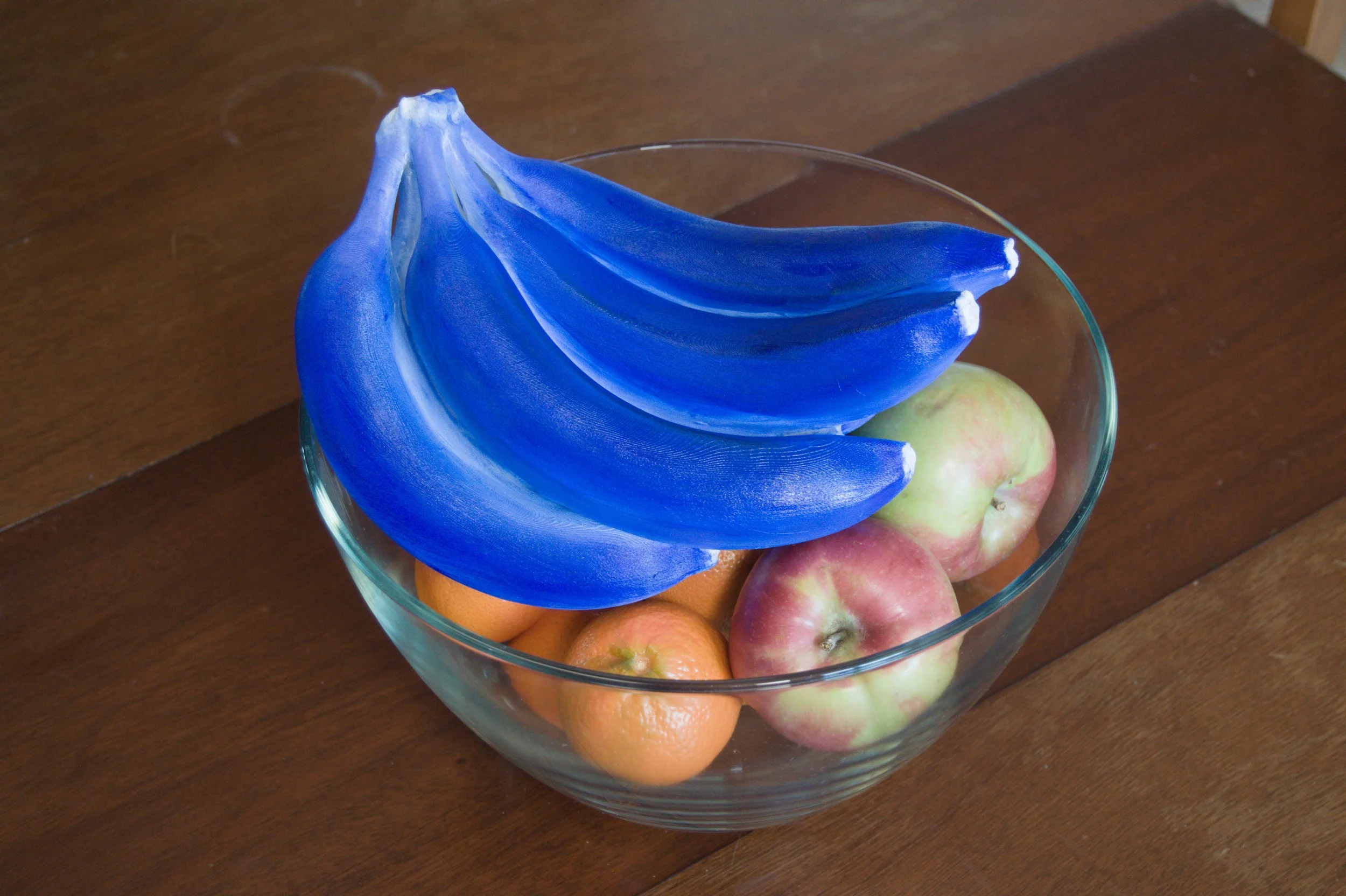
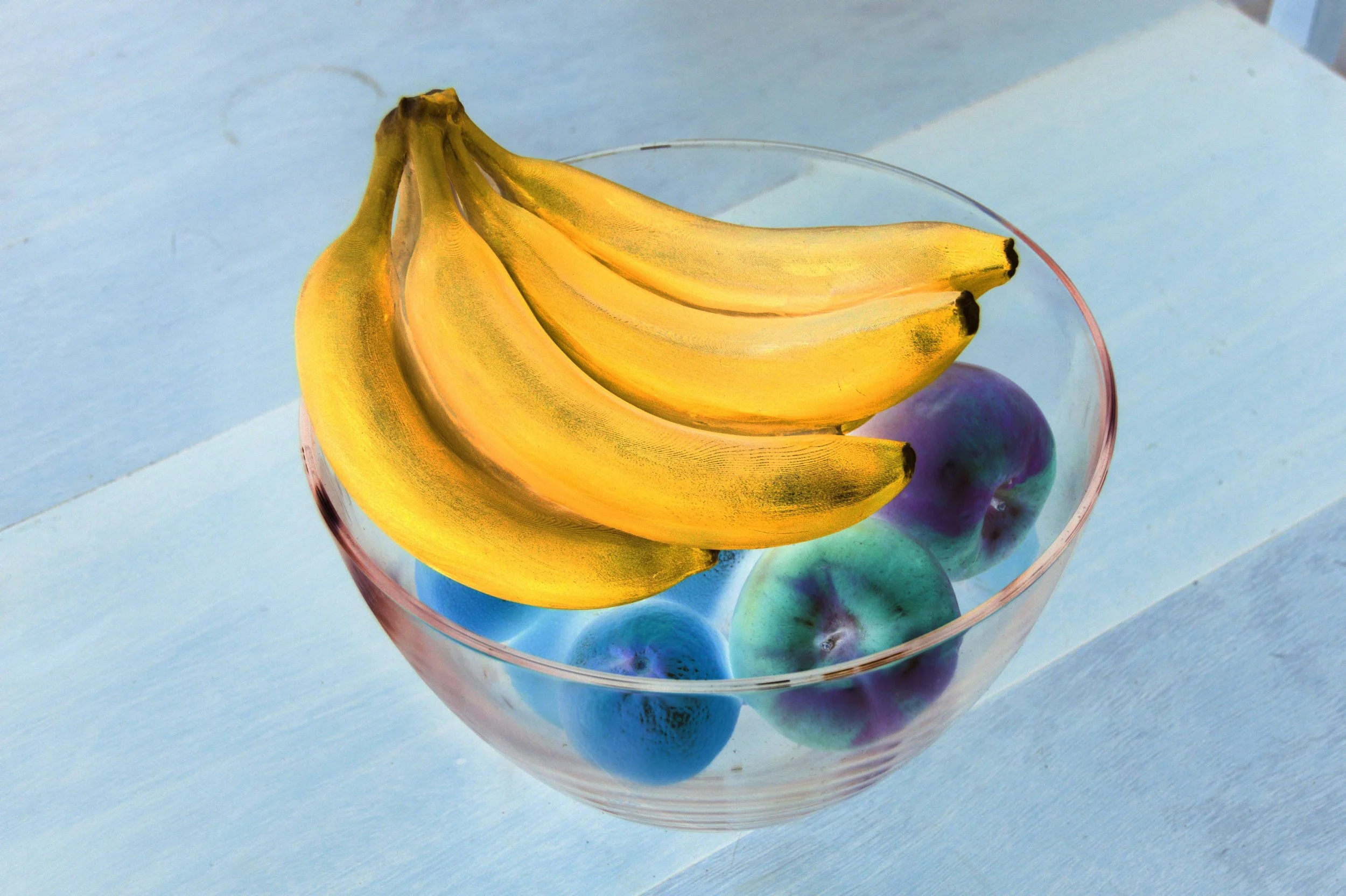
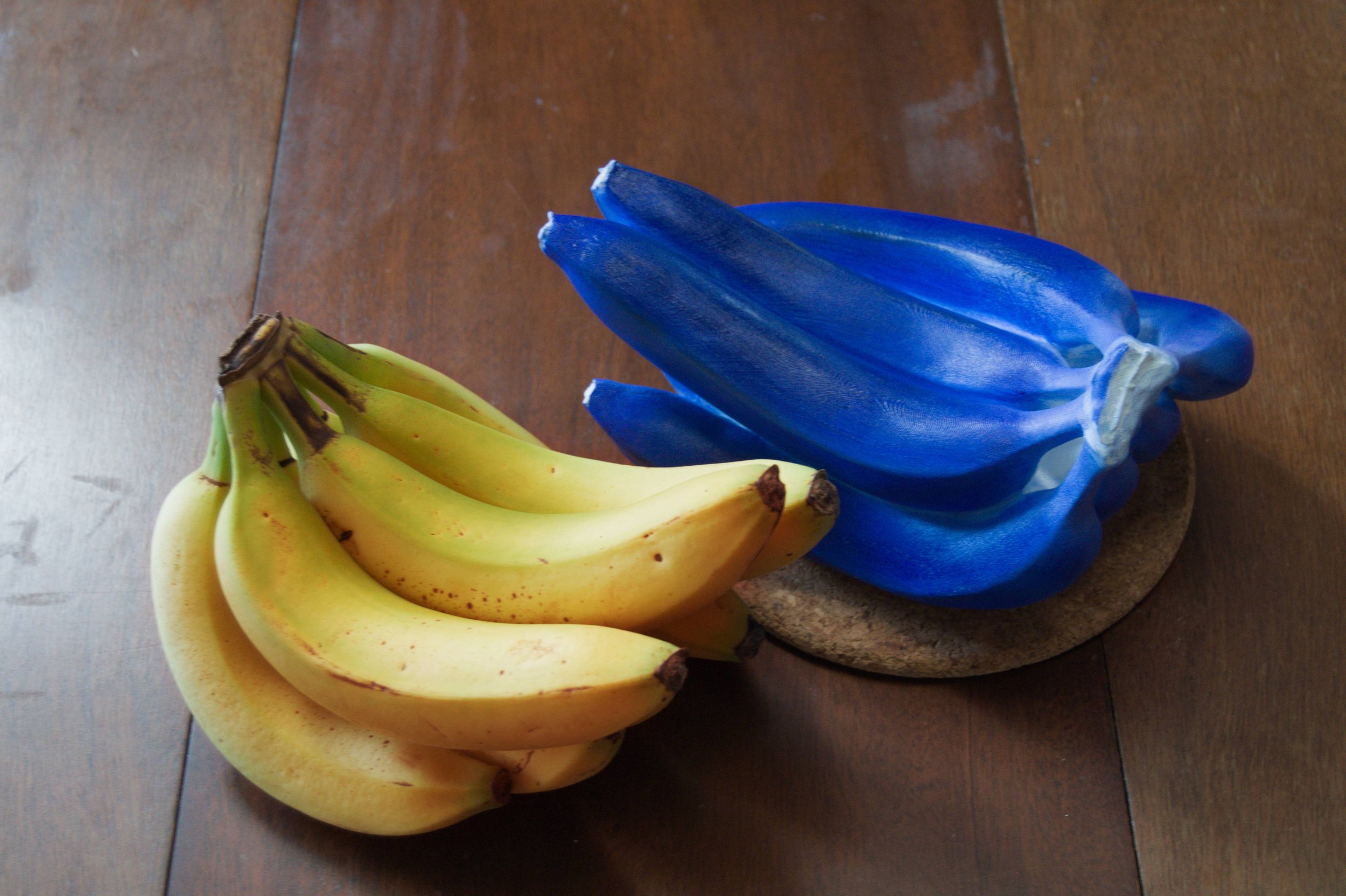
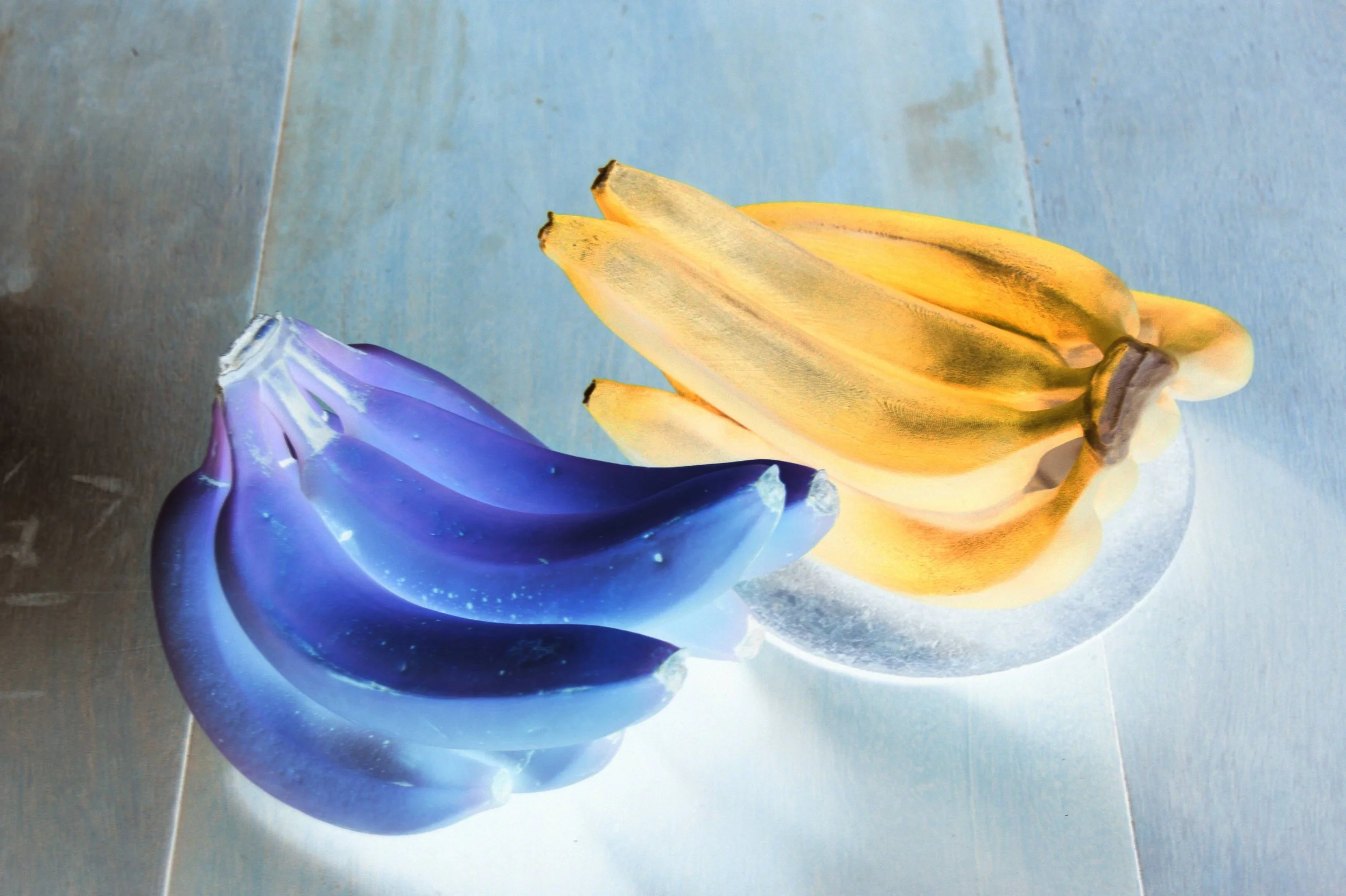
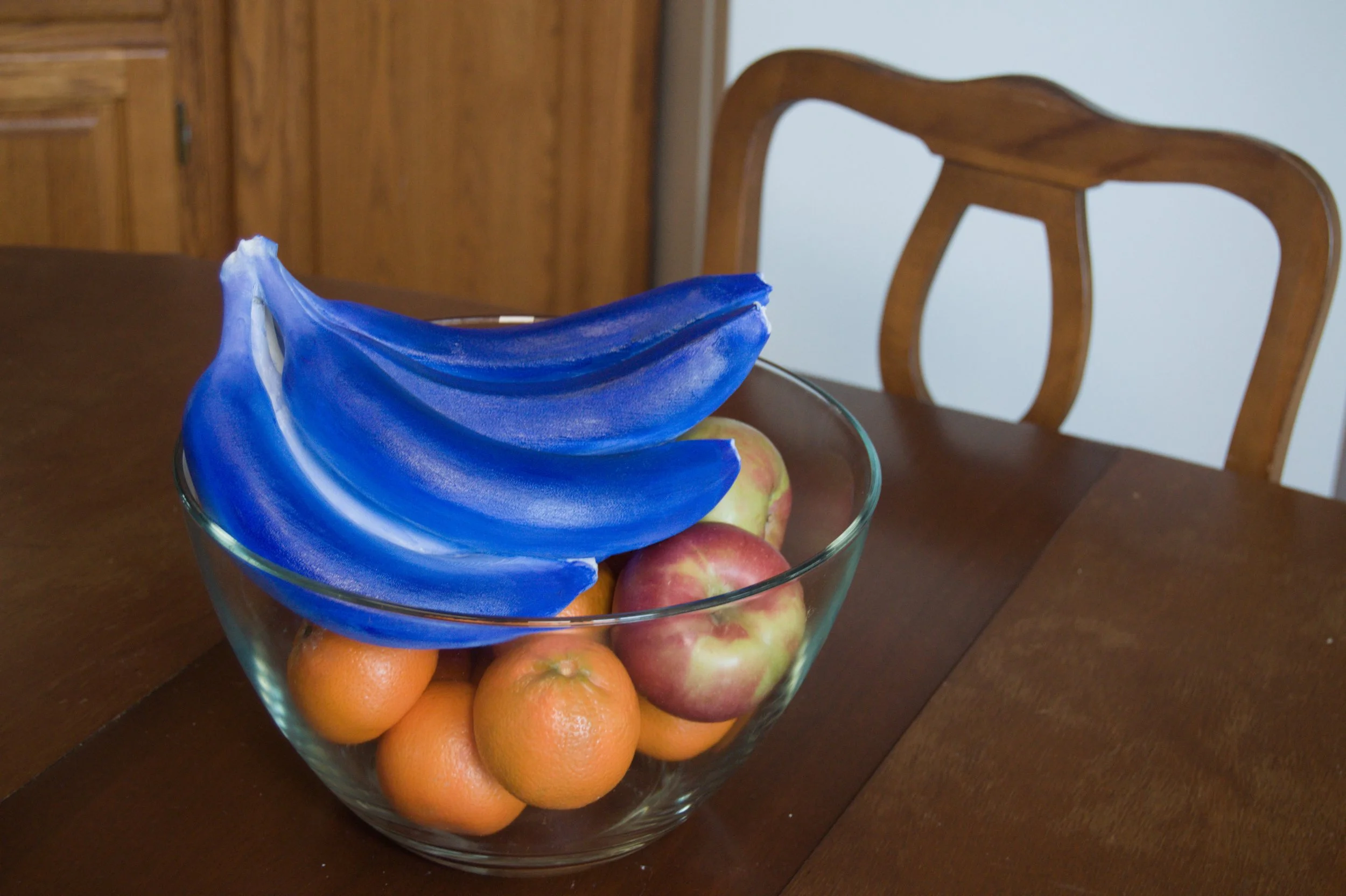
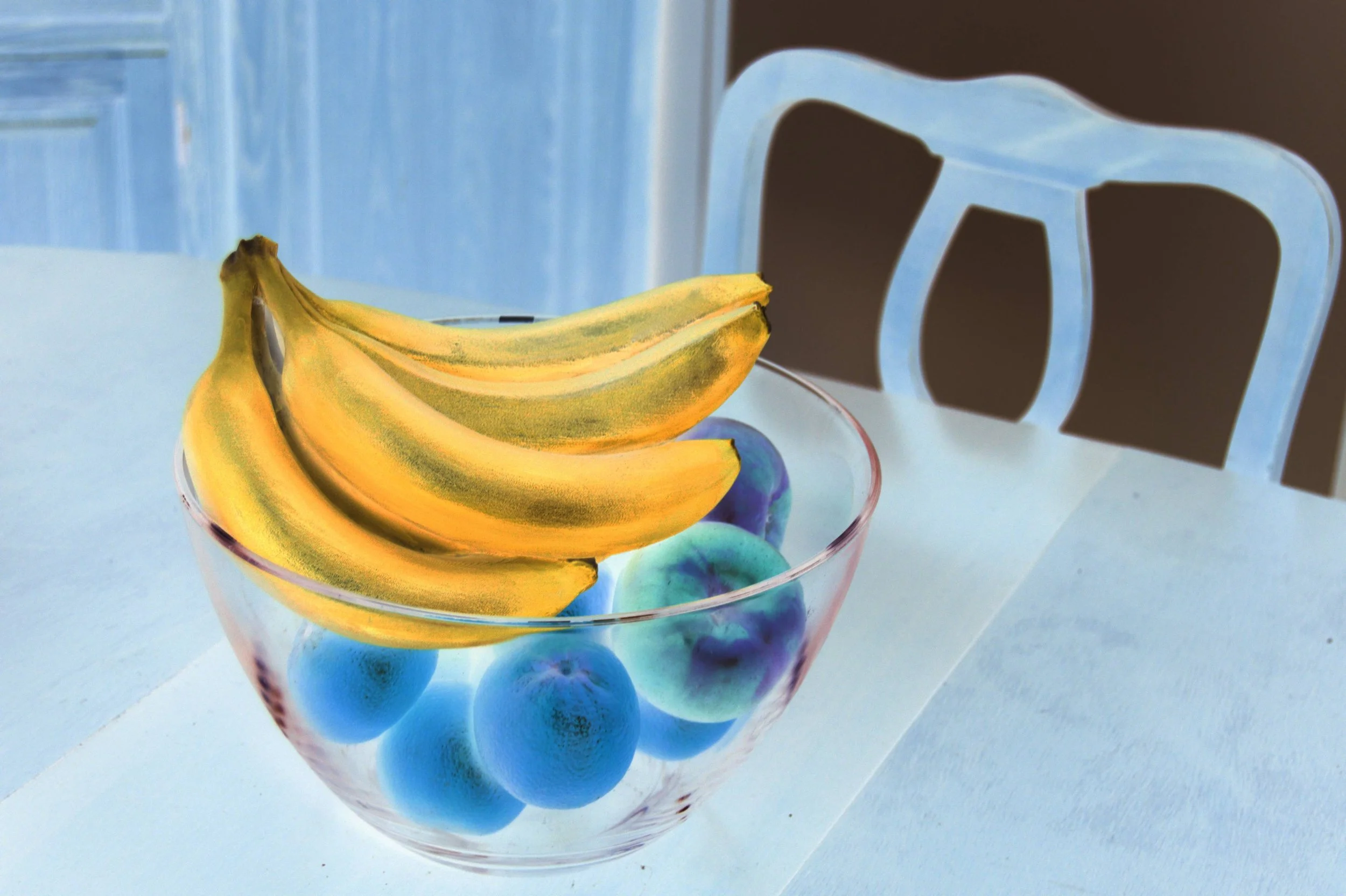
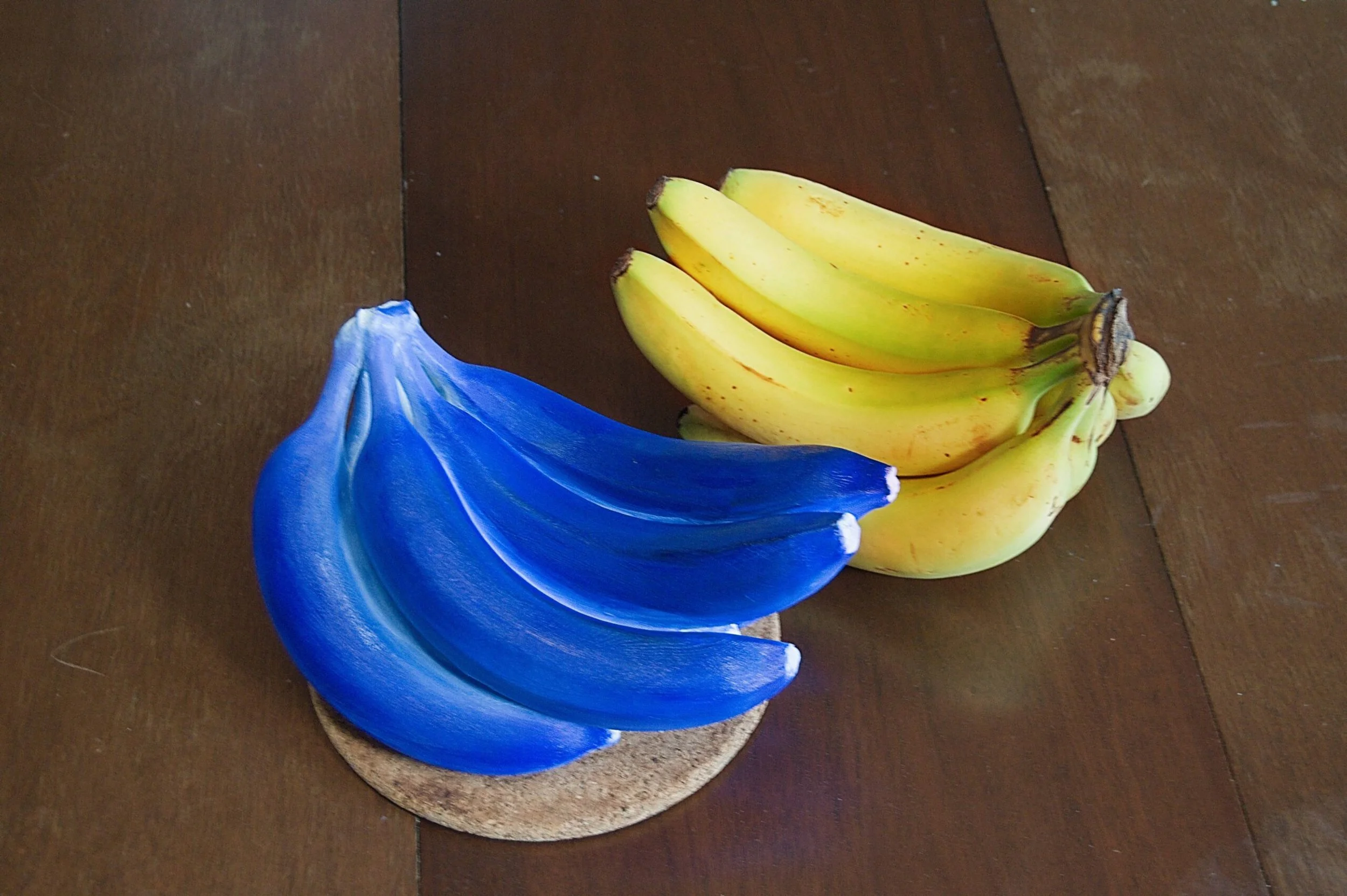
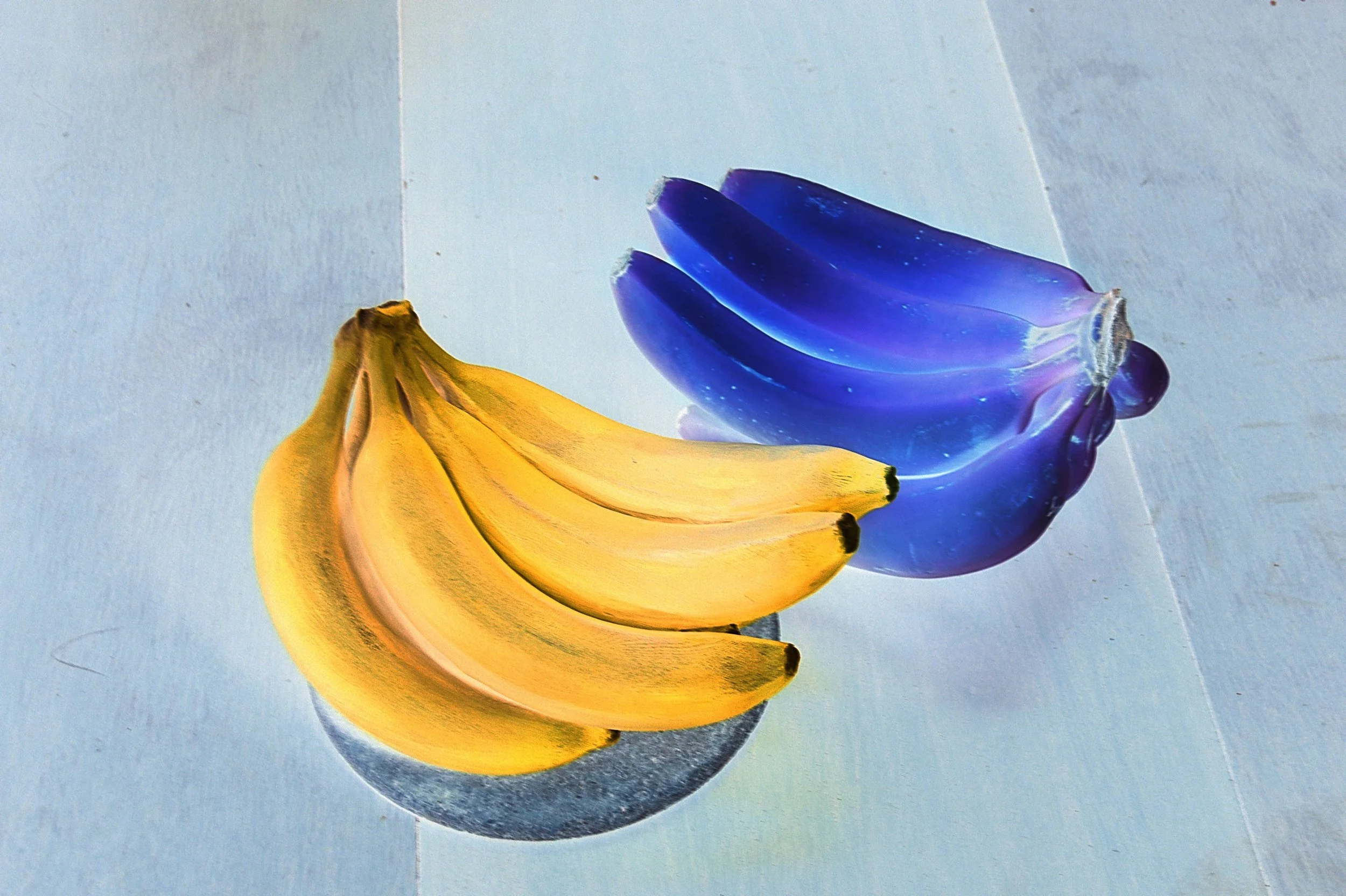
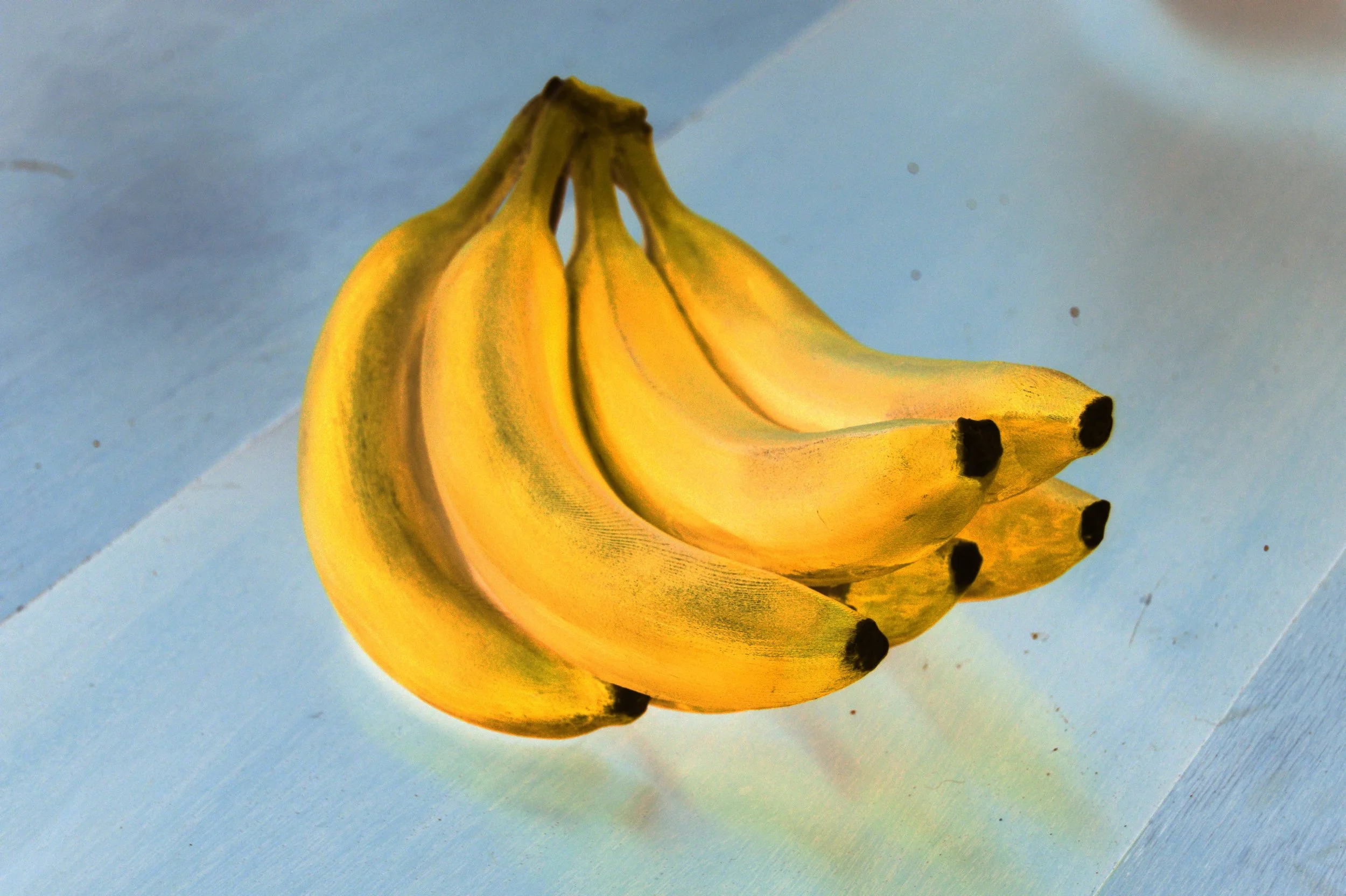
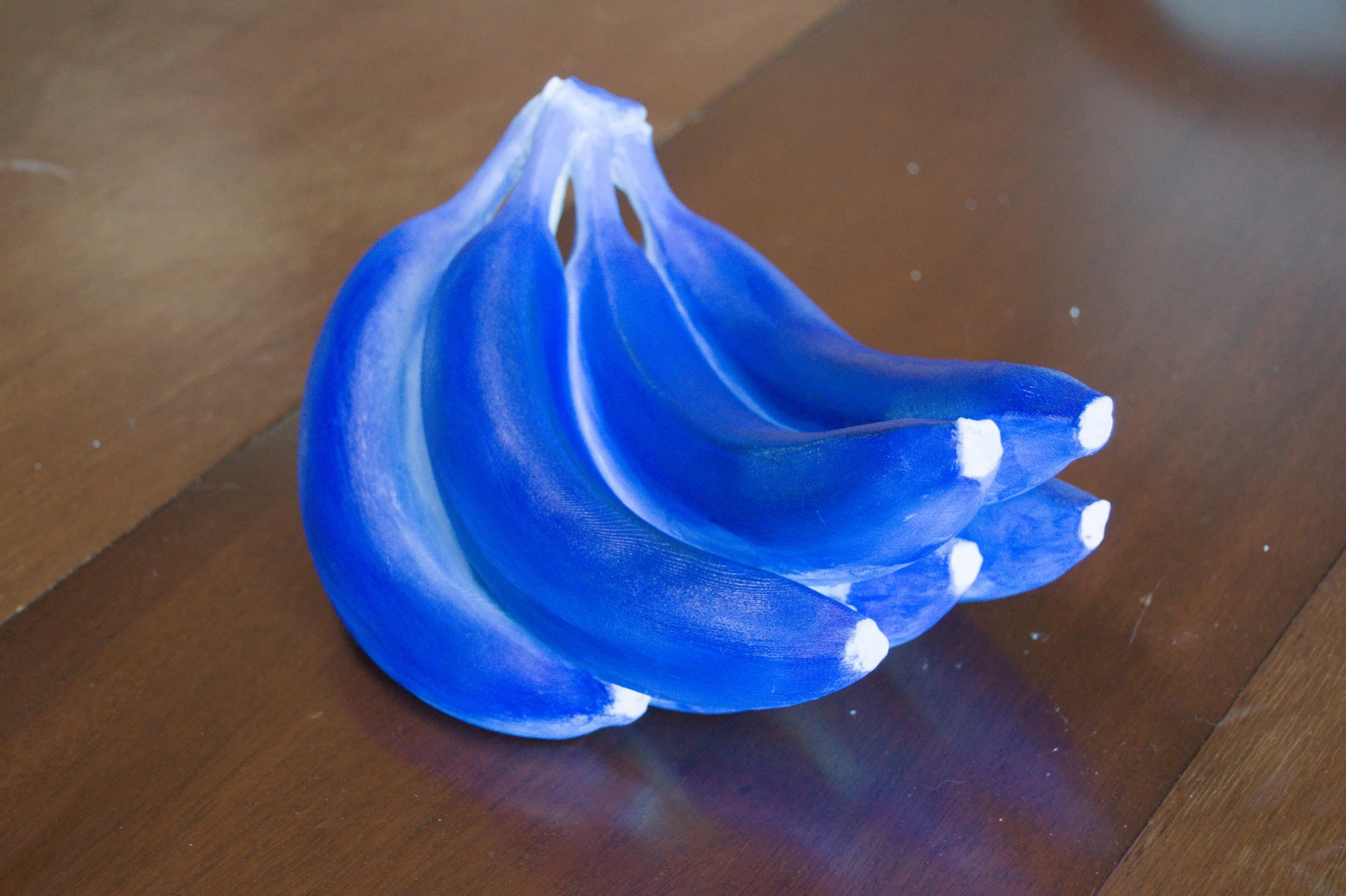
Nearly every banana you’ve bought from the grocery store since the 1960’s has been genetically identical. This is due to the industrial farming methods required to sustain the global demand for the worlds most ubiquitous fruit. The cavendish variety, the only commercially available variety in North America, is a hybrid of two other cultivars: one has abundant bland flesh and small seeds, the other flavourful flesh and large seeds. This hybridization has rendered the cavendish banana sterile. It is only reproduced via cloning: growing new plants from cuttings of existing plants. Banana plantations are filled with thousands of plants, each a clone of original hybrid. This extreme monoculture has left bananas exceptionally vulnerable to disease. This is exactly what happened in the 1950’s to the last commercial variety, the Gros Michel, which was devastated by fungus Fusarium Oxysporum TR1. A newer strain of the fungus, TR4, is now threatening to do the same to the Cavendish.
Bananas contain trace amounts of Potassium 40, a naturally occurring radioactive element. Approximately every 75 minutes, a banana will emit one positron, which is the antimatter equivalent of an electron. When antimatter encounters matter, the two annihilate releasing energy.
I have memories of being on family vacations and saying “I’m hungry” hoping to get a snack from a food cart or restaurant I’d just seen. My dad would pull a Banana from his pocket and offer it to me. I would refuse. My goal wasn’t to resolve my hunger, I wanted the junk food. “Well you can’t be that hungry then” he would reply. He was right. I carry bananas in my pocket or in my car for long drives.
This work represents a constellation of ideas that form around a single object
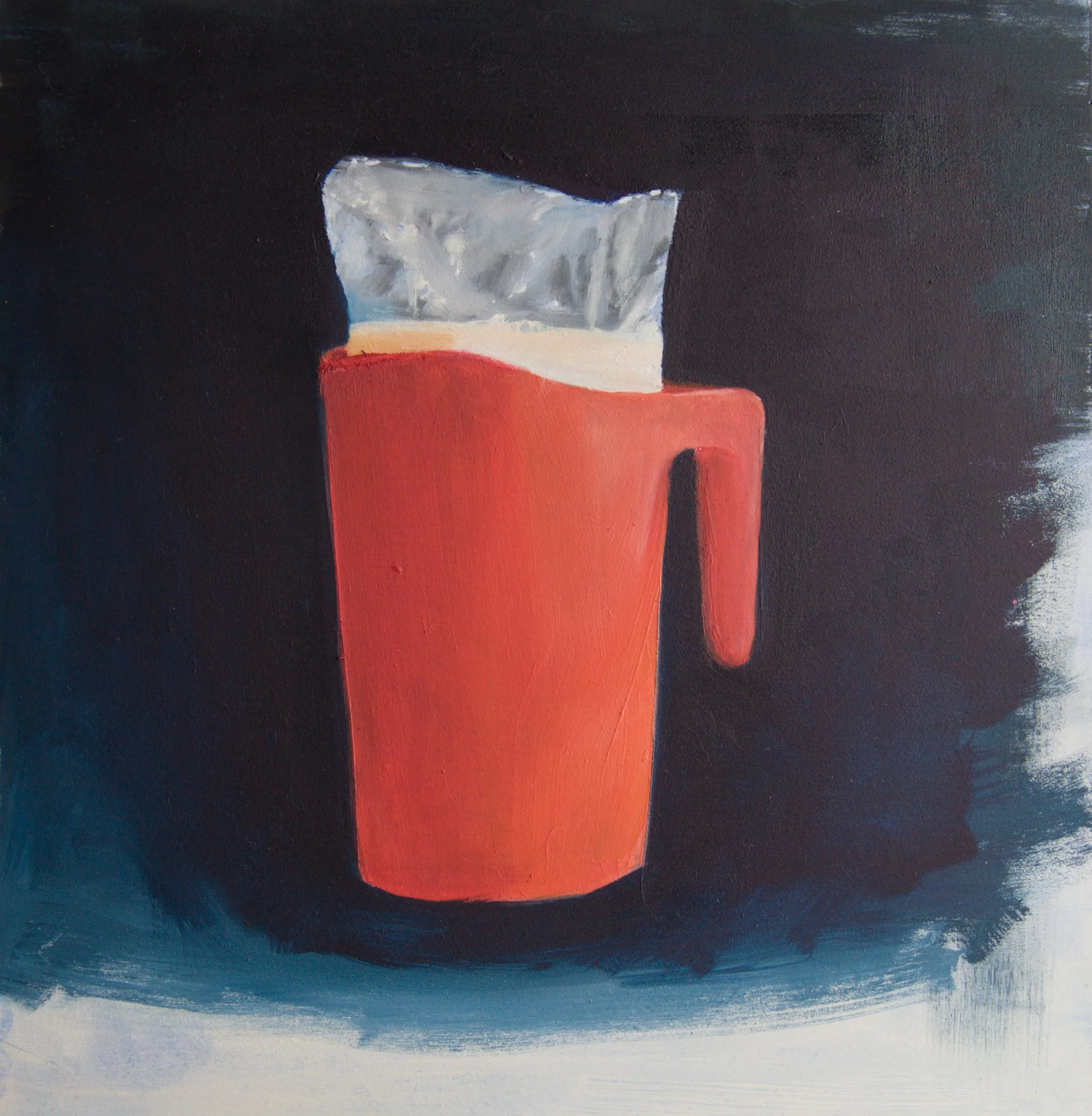
Milk
(Why is this how we do Milk?)
(2026) Oil on Panel
This work is representative of an exploration of still life as an extension of a found object practice. The orange plastic pitcher belonged to my grandmother. It is older than I am. I inherited it when I moved into my grandparents’ house, and use it daily. I have used bagged milk my entire life. That doesn’t make it any less frustrating. How did structures evolve to bring us to this point? Can we move past bagged milk? would what we move to be better?
My grandmother would cut both corners of the bag to stop it from collapsing when you poured you milk. She also would roll over the pouring end of the milk bag and use a clothes pin to keep it closed, to “keep it fresh”. When asked why she didn’t clothes pin the ‘vent’ side as well, she would say “that’s too much trouble”
Bin Tower
(2026) 3d Printed plastic
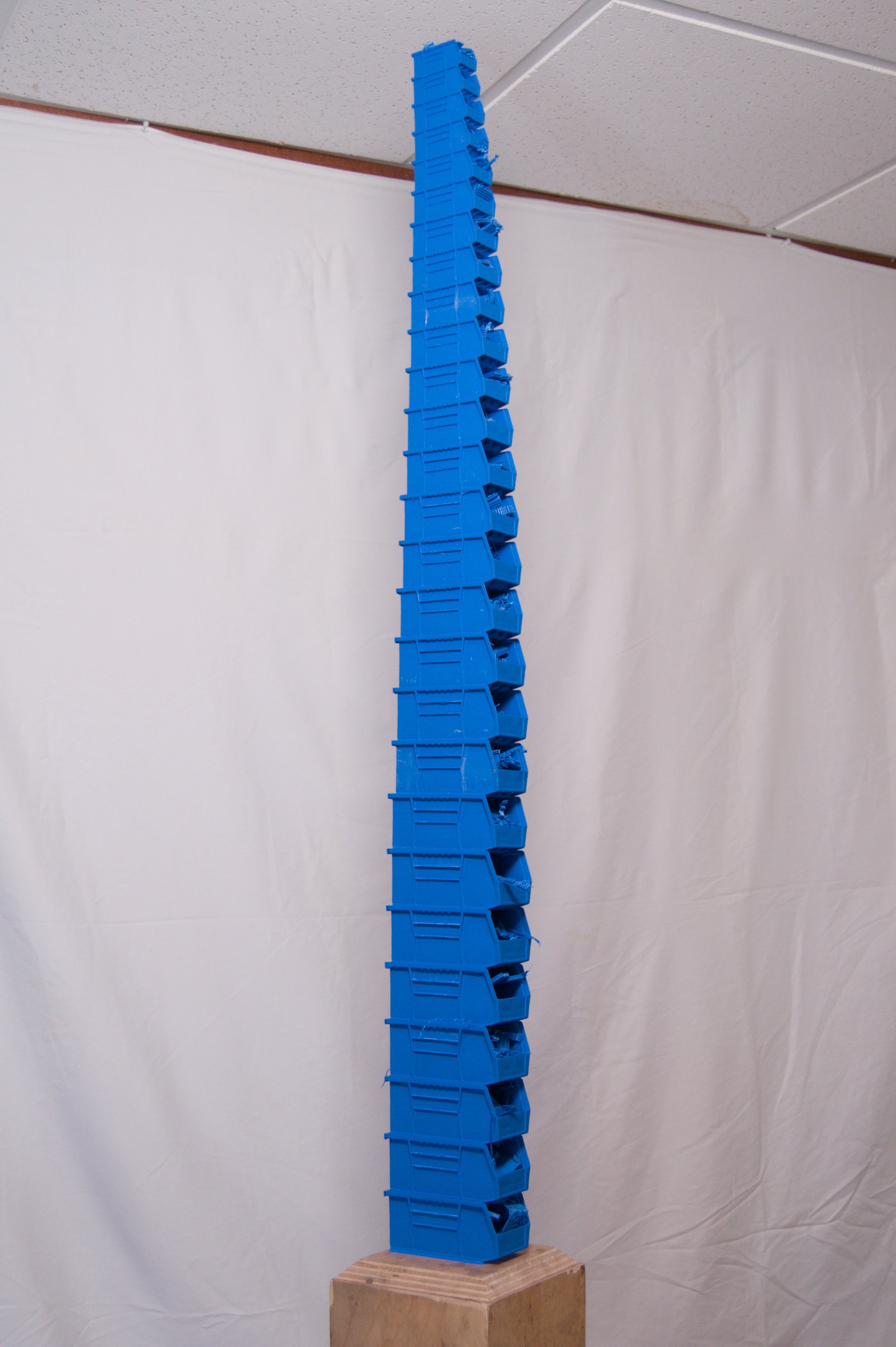
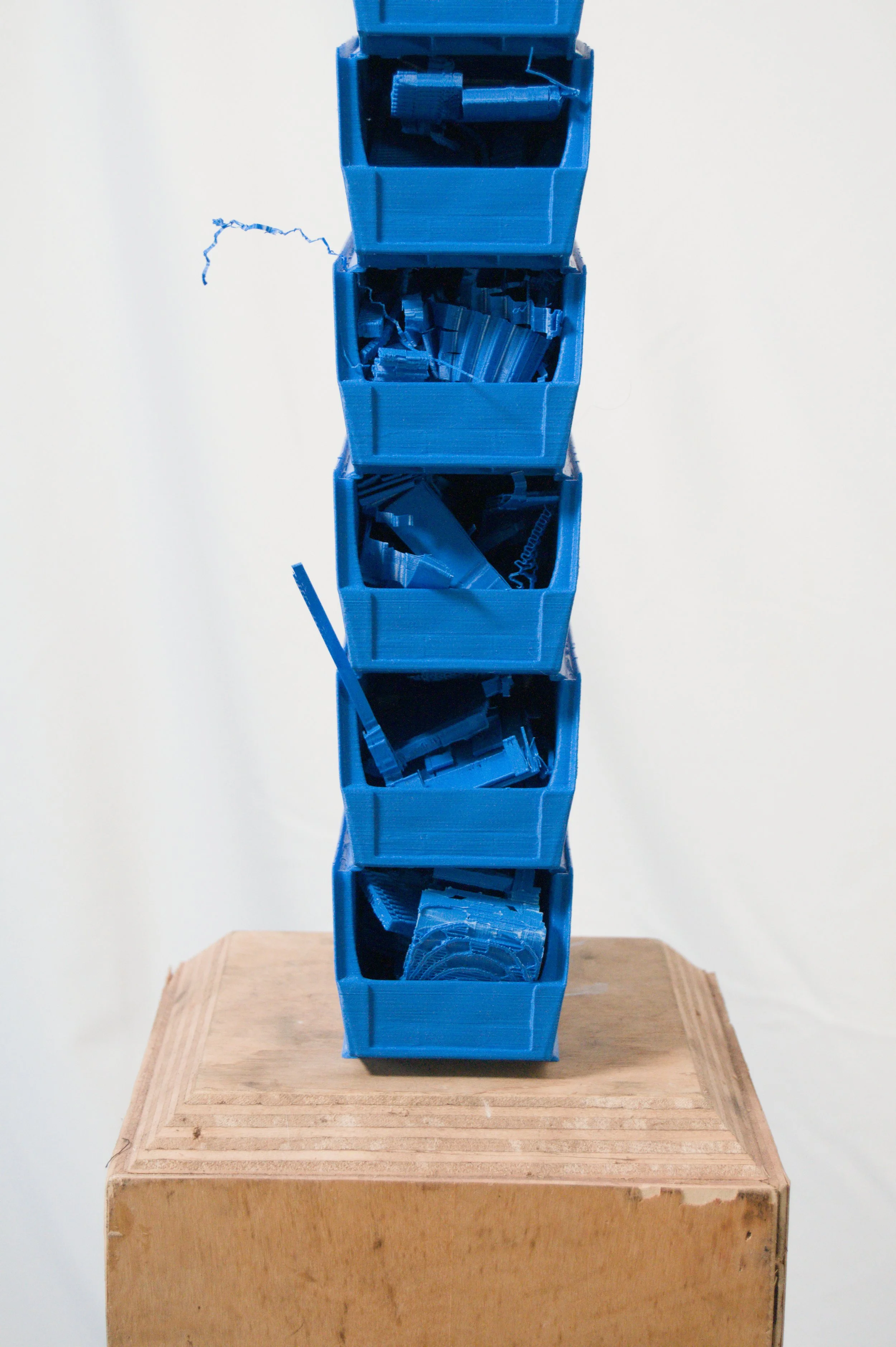
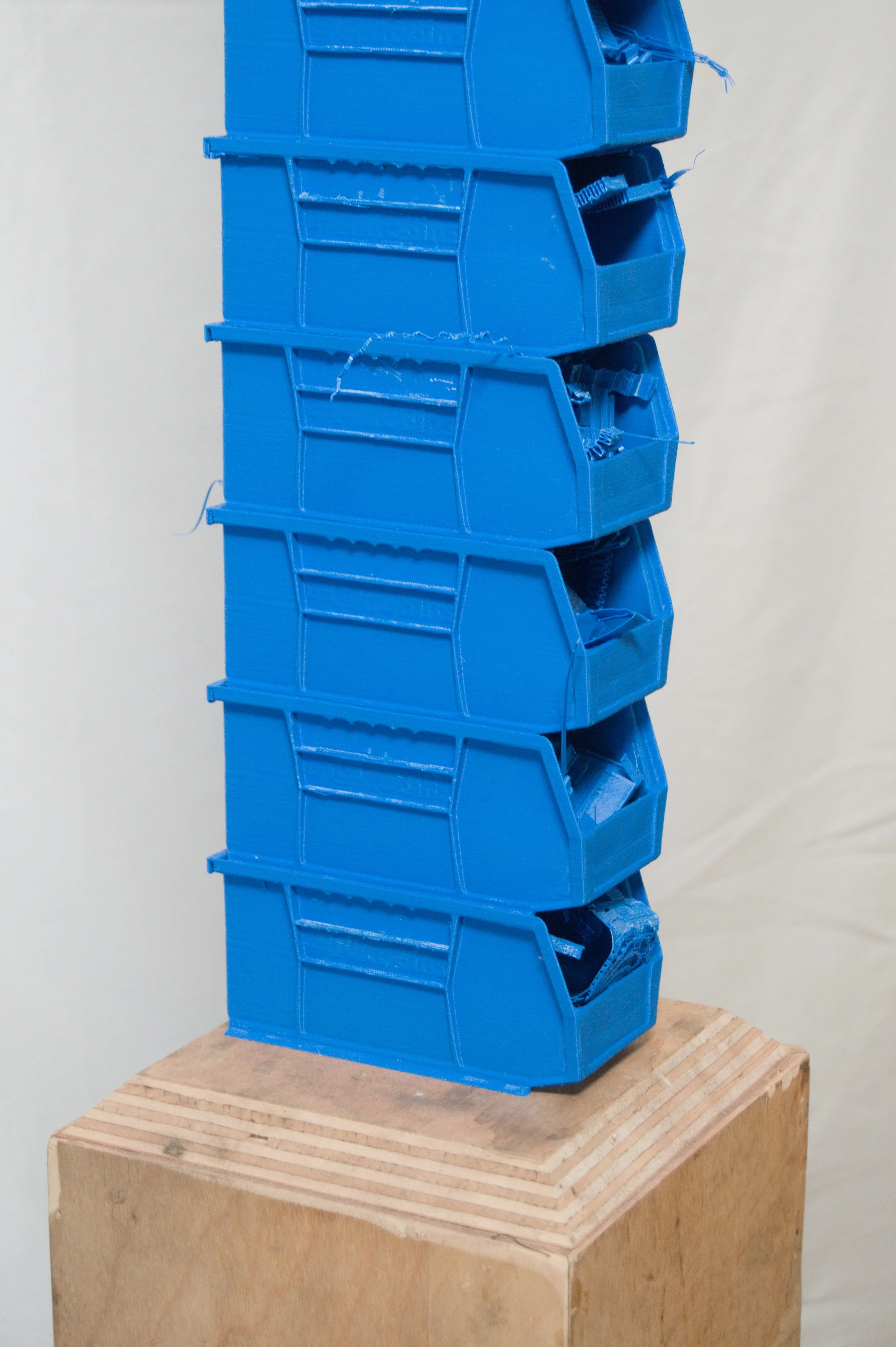
Structures replicate and support structures.
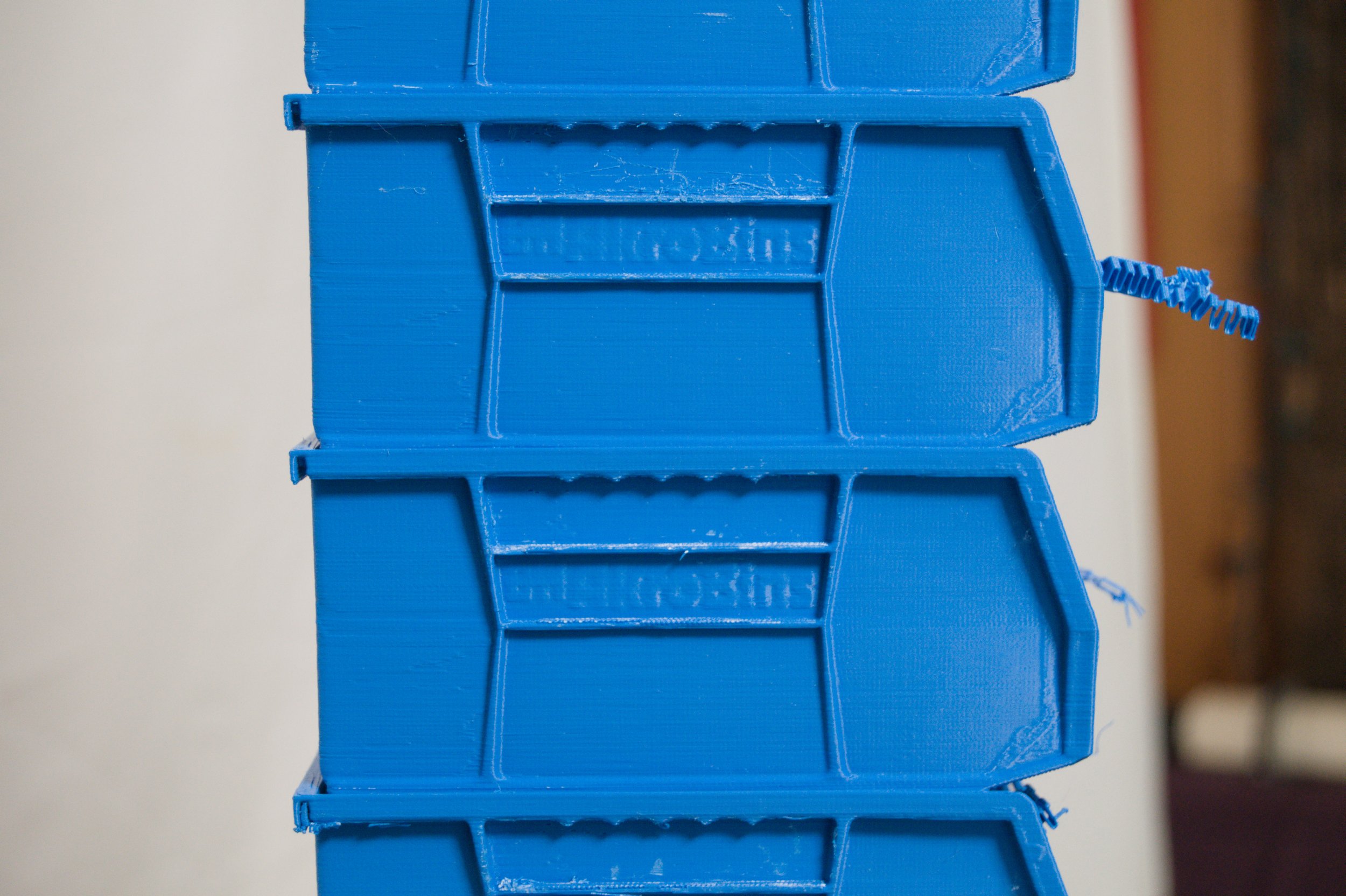
Each blue bin is a copy of the others, holding within them the supports that were necessary for their creation.
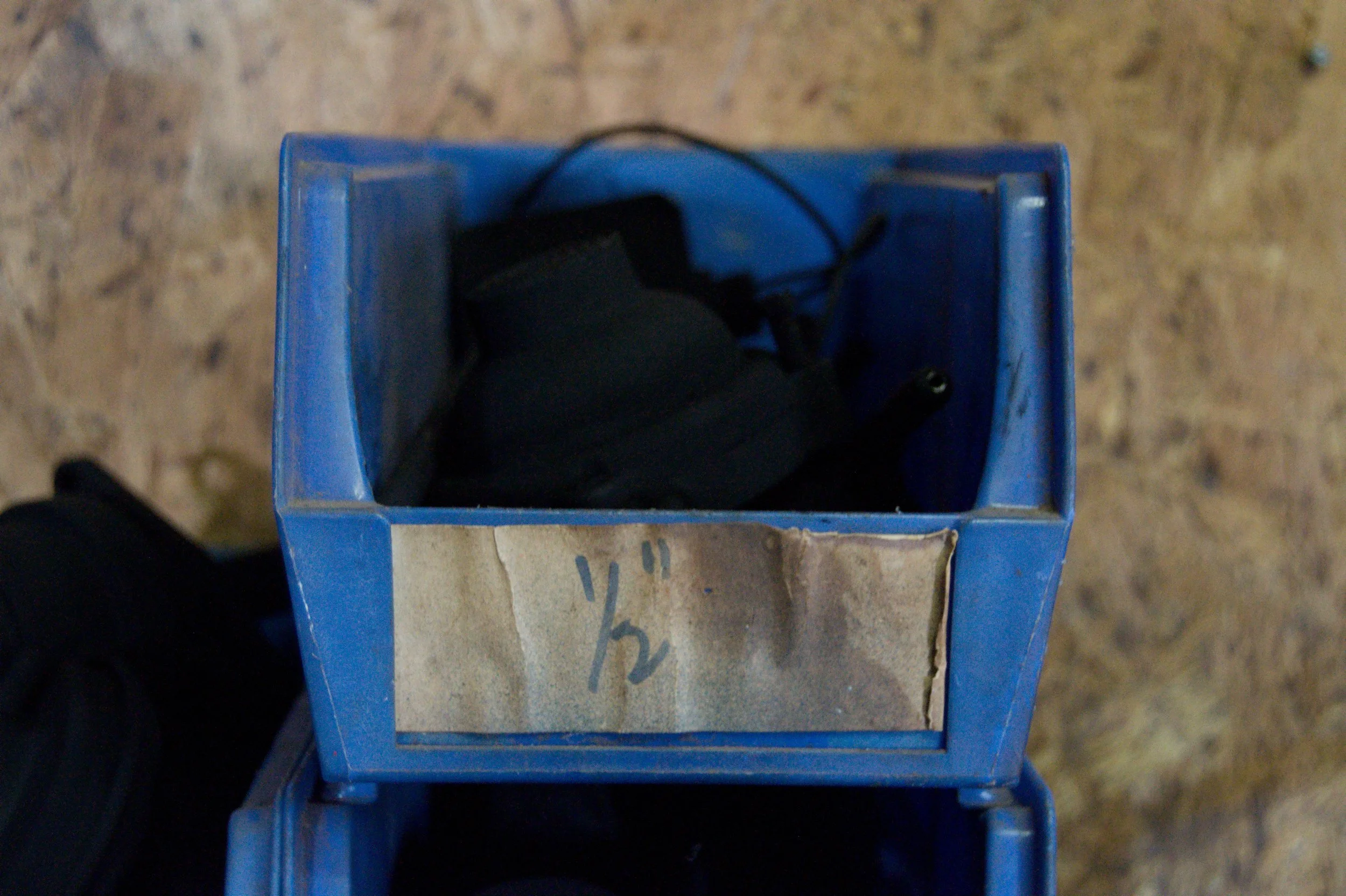
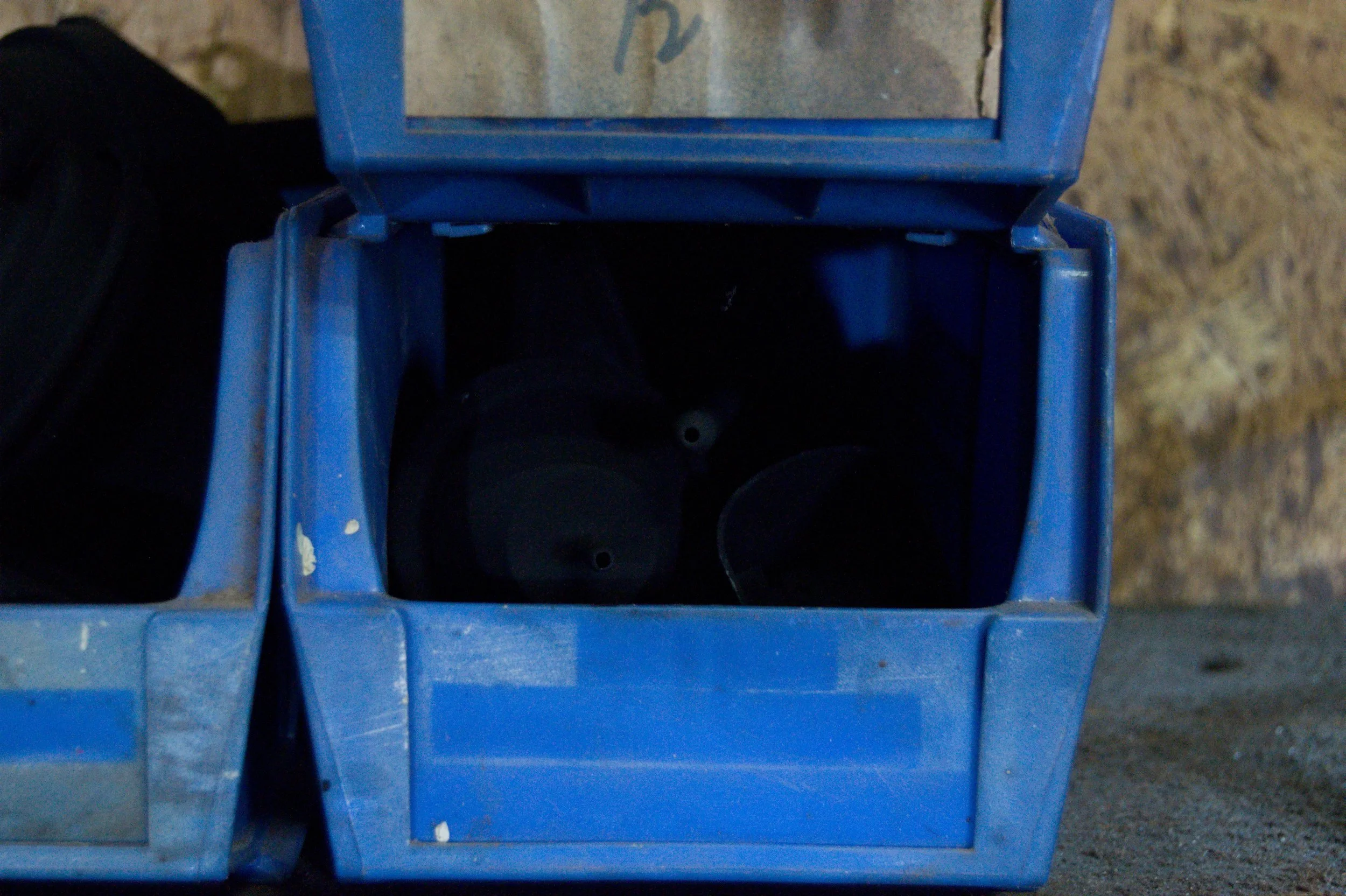
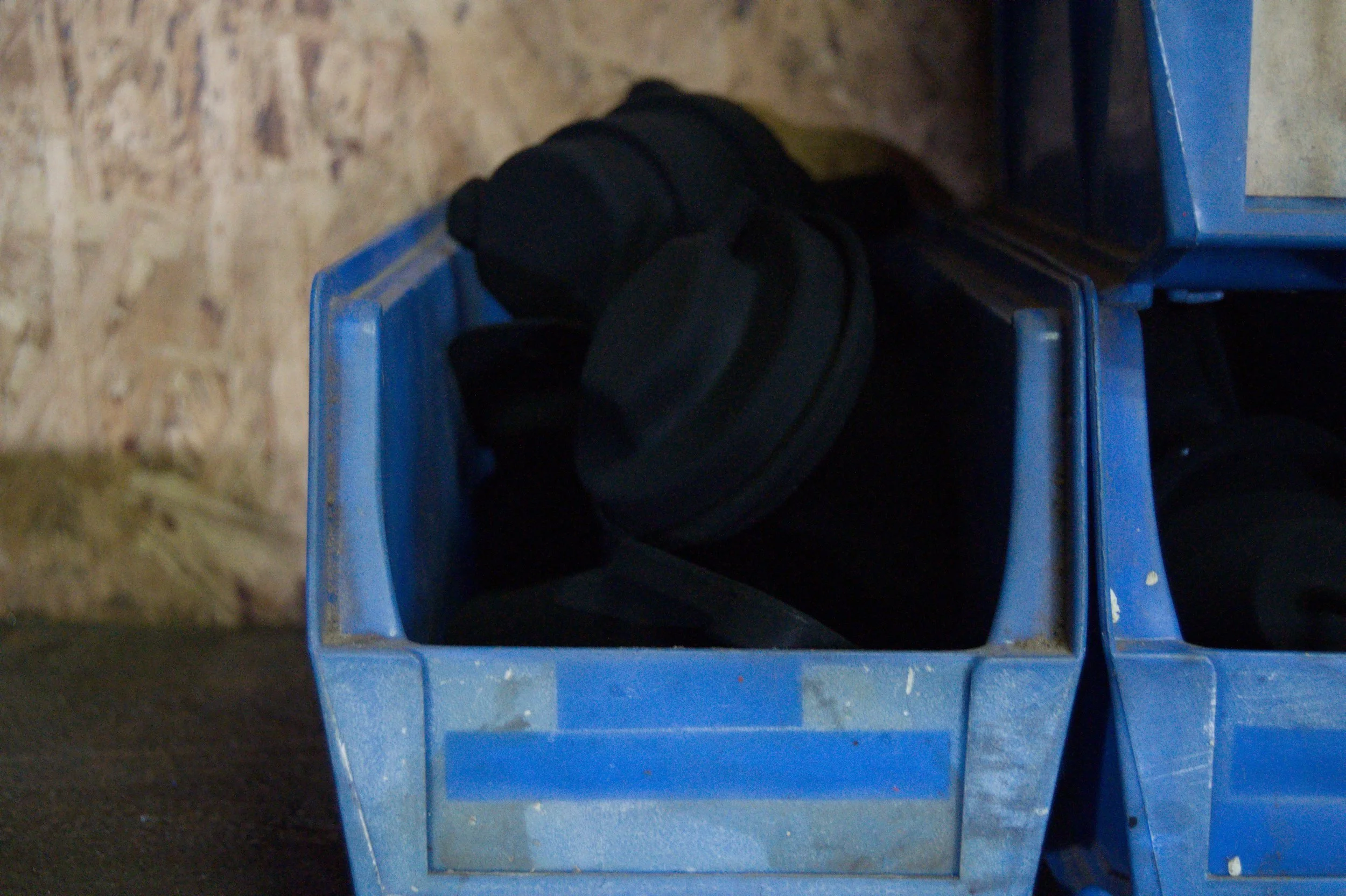
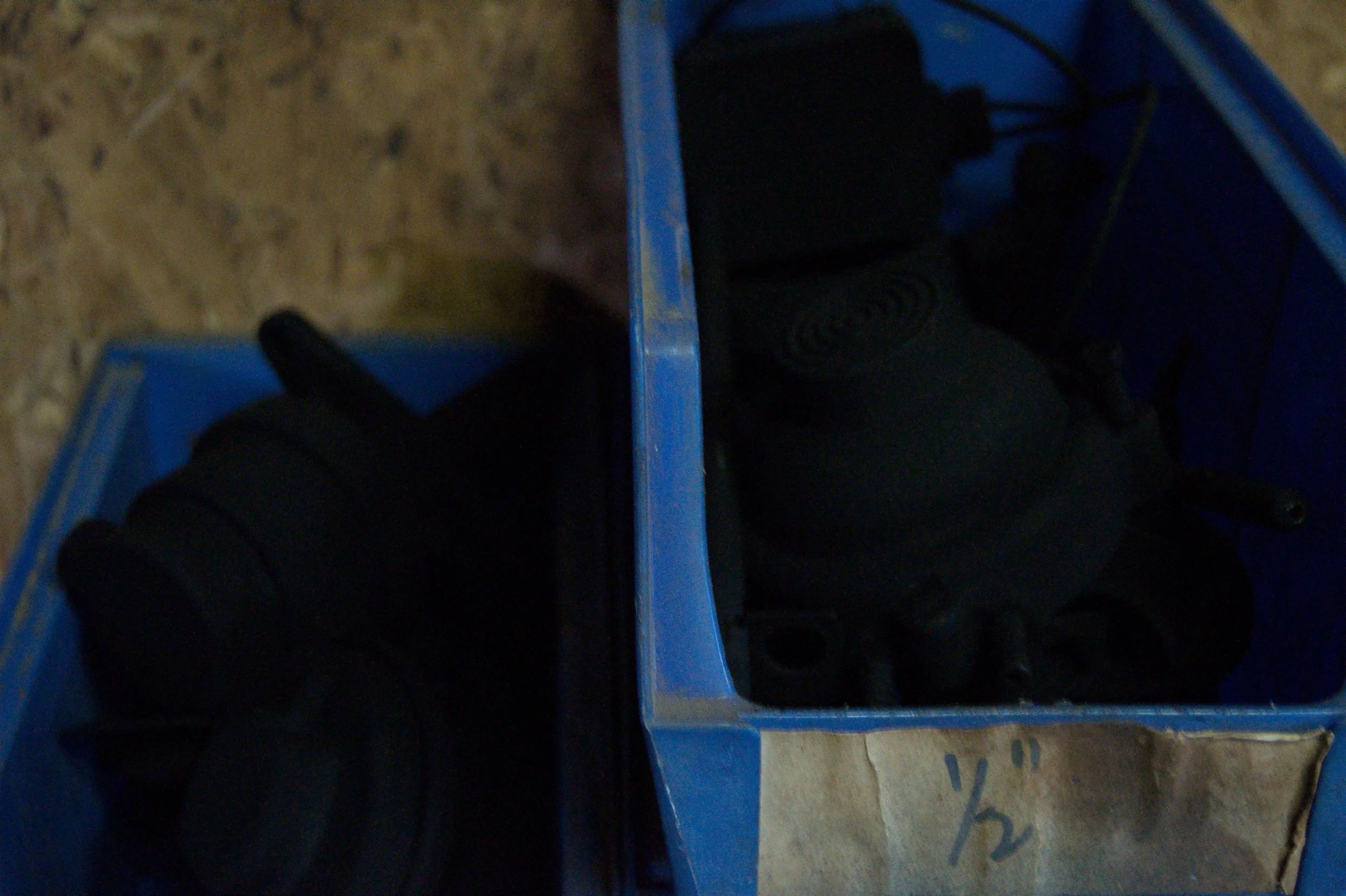
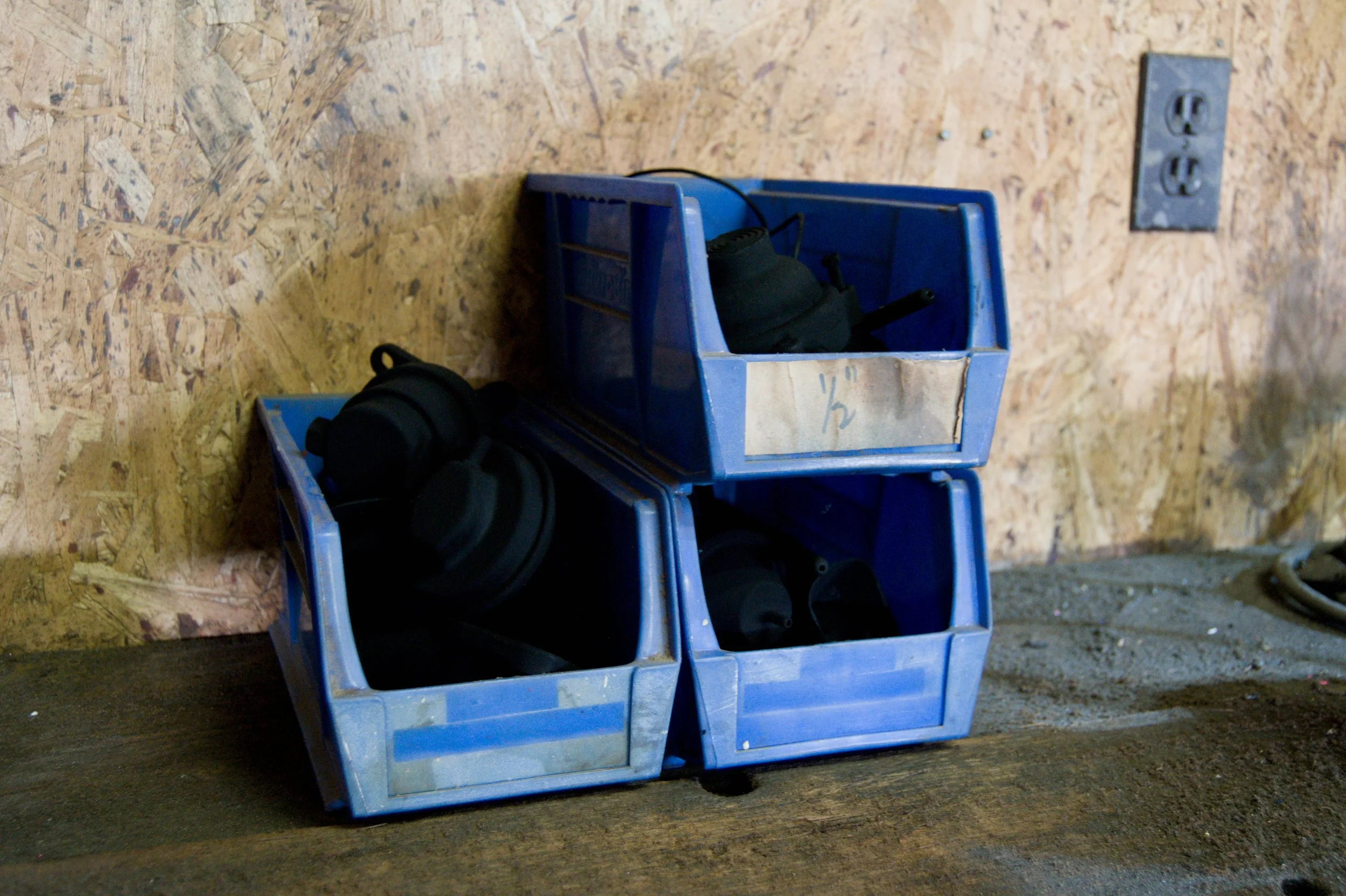
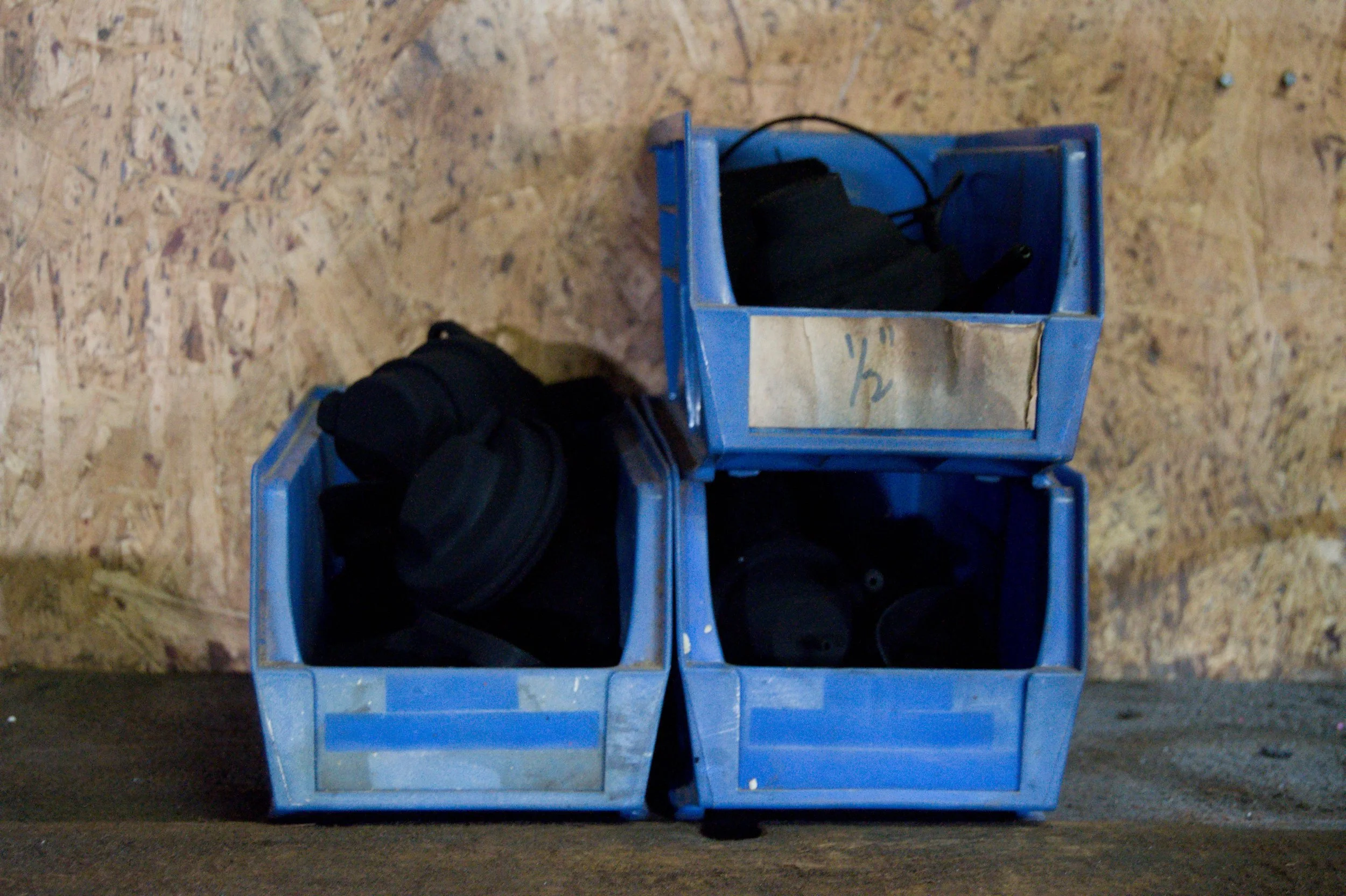
The bin is a replication of a parts bin that belonged to my grandfather. I have 50 or so such bins (Featured below in I think these are car parts). each filled with parts from some unknown engine, old screws, broken light fixtures, etc. I know nothing of the history of these items, only that they are now inhabiting the structures defined by these bins.
I think these are car parts
(2025) blue plastic bins, assorted car parts, paper label, "Musou Black" paint
With this work, I’m considering objects and their relations to structures. I’m confronted with the fact that I have no idea what the reality of the objects are, beyond that they may be car parts. I am not certain that they are car parts: they could be from a tractor, or lawn mower, or some other mechanical device. I find myself considering that even if I did know what these objects are that I would only know them based on their relation and effects on other objects. This is exactly what I am presenting in the work: Objects made illegible and only knowable by their relationship to each other and the structure of the bin they’re found within. This continues my ongoing exploration of structures, their traits, effects, and how they can be defined, while also navigating grief and loss.
These bins and their contents were inherited by me when I moved into the house that was my grandparents’. They belonged to my grandfather. His garage and workshop are now my studio. I felt the work should be documented in it’s natural habitat.
Turbulence
(2025) Cast Aluminum
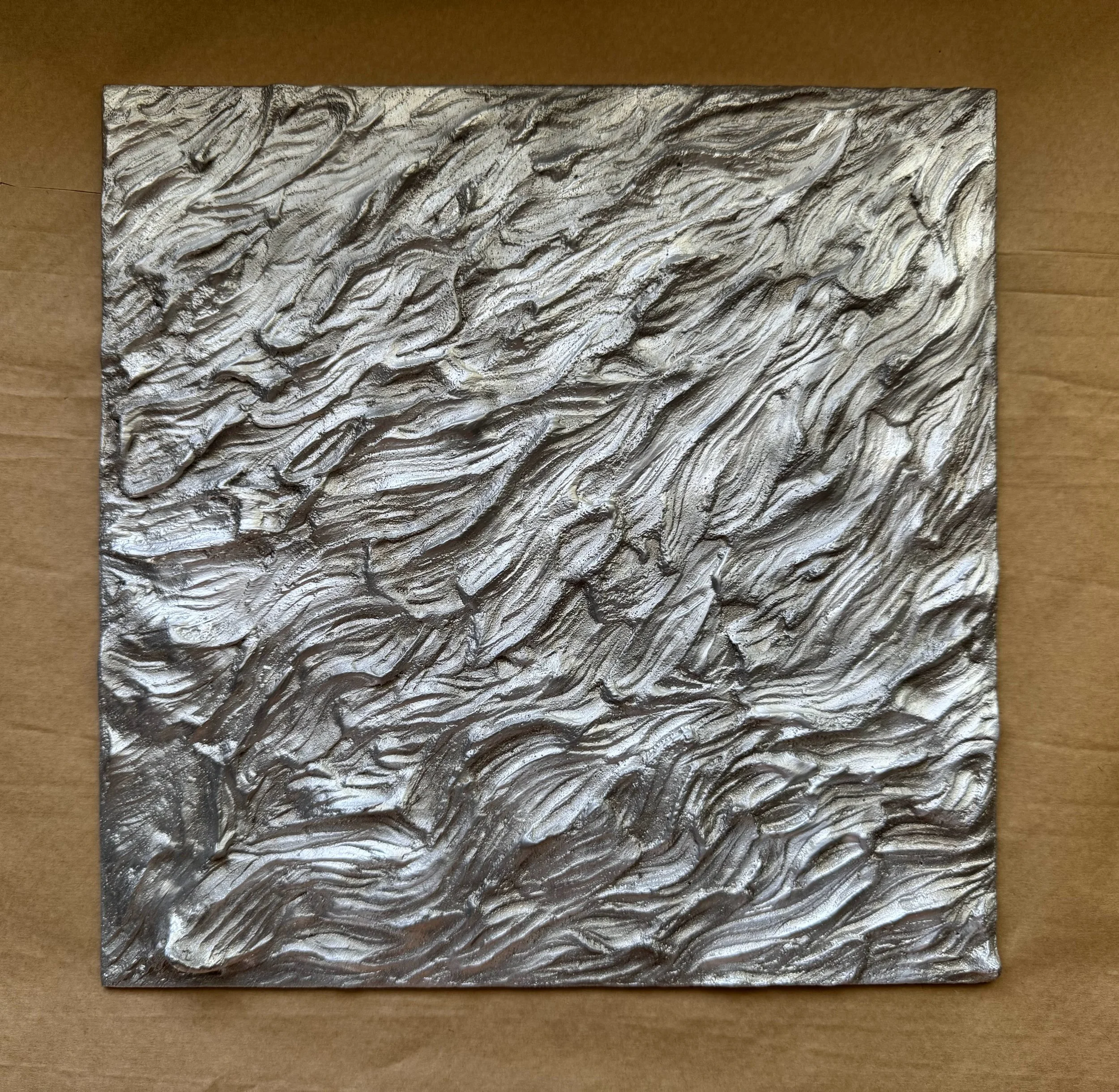
Turbulence is 12”x12” cast in aluminum in my home foundry.
The aim was to capture the flow of wind in the grass, while being loose and gestural, almost painterly as opposed to a realistic rendering of grass in the wind. I was inspired by a conversation with a friend about the concept often getting in the way of making the work. This is my attempt at taking a simple idea and distilling that idea into an object.
User Interface_0
(2025) Cast Iron, Brass, Enamel
Cast at the CSCIA Iron Pour 2024


User Interface_0 is the first of a series, in development, that draws connections between digital tools and their physical ancestors. This series is an attempt to isolate the portion of the tool designed to interface with the user and present it as an object to be considered. By titling the work User Interface I aim to bring the viewer’s thoughts to computers and computer programs, a context in which we most commonly hear that term, and re-frame computers and their programs as tools like a saw or a hammer.
Untitled, For Bud
(2024) Hand Saw (Steel, Wood, Brass)
My Grandfather taught me how to paint. We’d use the dollar store acrylic paints, and used the lid from a margarine container as a palette. Our canvas was hand saws. My grandfather would paint quaint farm scenes, countrysides, and placesfrom his memories on all kinds of saws. I wanted to paint dinosaurs and rocketships. We sat together at the kitchen table painting our saws until it was time to wash up for dinner. He was pretty good too. He sold a number of them at craft shows, and there’s more than a few of them hanging on the walls of my living room. Growing up I was very close with my grandfather. Living in what used to be my grandparent’s house means I’m constantly reminded of things I’d long forgotten. When I came out to my grandparents, I was surprised at their understanding, but my transition had also made me self conscious. The relationship had changed. The love was still there and we were very much still family, but I felt different and guarded. We had grown apart. Coming out is like that a lot: you change the relationship in a fundamental way; things aren’t different, but they are. You’re the same person, yet a different person. In the best cases, things carry on like they always had. In others, they end completely. Somehow the worst cases are the ones in between. You become acquaintances with people you love the most.


Ritual
(2023-2024) Plywood, Resin, Spraypaint

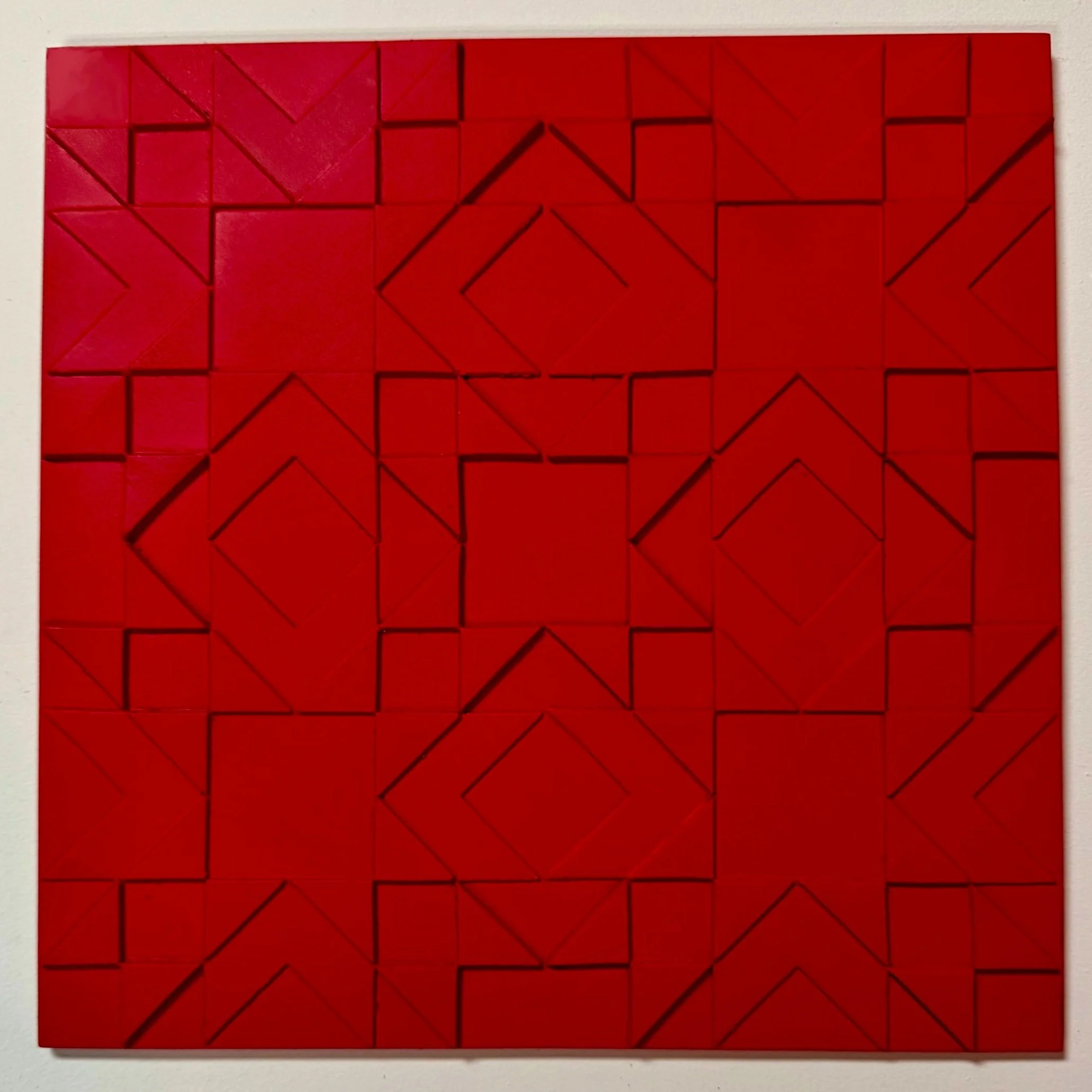


Ritual is an exploration of building identity through fragments of repeated action. The pattern is a double star quilt block rendered in 3 dimensions, cast in resin 24 times, assembled then painted. The tradition of quilting is a highly ritualistic act; a specific set of steps are followed and repeated to build an object of significance out of otherwise discarded fabric.
I first became fascinated with quilts as a concept when I underwent gender confirmation surgery. Before the surgery, I had expected that I would feel completeness, as if a major chapter in my transition had reached its conclusion. During my recovery, I felt relieved and happy and a whole host of positive feelings, but at the same time, there was a lack of finality. The occasion had come and gone and felt unmarked. I didn’t feel any more or less of a woman than I had before. I began to research coming-of-age and womanhood rituals and learned of the strong tradition in western history of women making quilts to mark milestones.
This work is one of a number of others titled Ritual, all using the language of quilting. Each work cements a small piece of my own ritual of becoming—taking the fragments of lived experience, combining them through a ritual of creating identity, and defining what womanhood and femininity mean to me.
Cube 1
(2022) Cast Iron
Cast at the CSCIA iron pour 2021


Cube 1 is a cast iron form consisting of 3 contiguous sides of a cube, and a concave in place of the other 3 sides. It is an exploration of perception and identity. You can only see 3 sides of a cube at the same time, our mind extrapolates the rest of the cube. It’s only by moving around the piece that the viewer gathers more information and learns its true form. The form was designed digitally, with the concave specifically made to accentuate the sharp edges and triangular faces of low resolution digital shapes. The intention is to mirror how we create digital identities that we share through social media. Those identities are partial versions of ourselves that we want others to see. The inverse is also true. We build a mental identity of the people we see online, based on the curated information we’re presented. The entirety of the person—the truth of who they are—is obscured.
Wrenches
(2012) Bronze, Black Walnut, Aluminum
Cast at the OCAD University Foundry


Wrenches shows the deterioration of a tool into a concept as it becomes more digital. A wrench as a tool in a physical reality exists as a form with function, an object with purpose. That function alludes to a user. A person to wield the wrench and use it for it’s designated, or some undesignated, purpose. When that wrench is scanned, and reproduced in a virtual reality, it looses that function. It becomes the signified. It is the concept of a wrench.
Arc Furnace
(2012) Steel, Refractory, Graphite Electrodes, Oak, Insulated Copper Electrical Leads
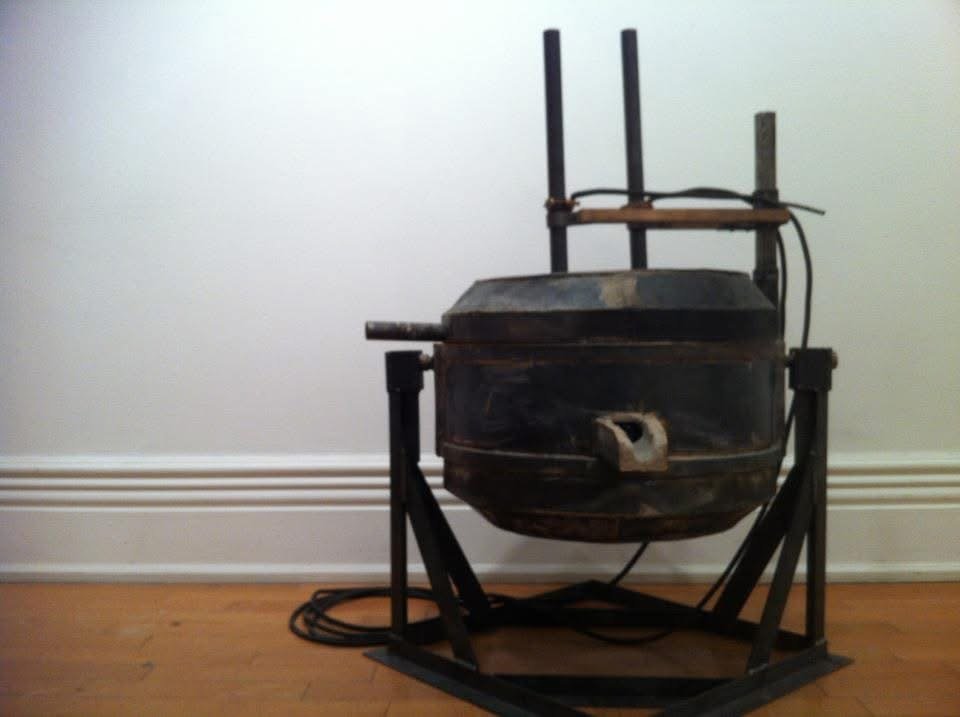
Arc Furnace is a theoretically functional Electric Arc Furnace (EAF). EAFs are used in the recycling and production of steel. In my home town, there is an old steel mill. It looms over the city of Welland’s east end. As a child I always wondered what went on in those big metal buildings. As it turns out, when I was a child, nothing went on in there. The mill was empty. Shut down due to mismanagement and low steel prices. It wasn’t until my late teens that I learned about the Atlas Steels Company, and the marvelous machines they used to create steel. Industrial processes are a wonder to behold, and they’re often something taken for granted, especially with something as ubiquitous as steel.
After my undergrad, I served as a millwright apprentice for a few years and had an opportunity to work in steel mills performing maintenance. The awe when a 20 ton billet of orange hot steel hits the rolling mill never went away.
Near Enough is Close Enough
(2012) Maple


I was working in the shop with a machinist’s square. I knocked the square off the table and on to the ground. I picked up the square and worried that the blade may have been knocked out of square. I then found another square to check how square the recently dropped square was. It then occurred to me that the second square might have been dropped as well.
A machinist’s square will will come with some indicator of how accurate it is, or conversely how inaccurate it is. The geometric constants we use as reference—flat, level, square, plumb, etc.—are all impossible in a physical form. In essence to exist is to be imperfect. To reflect this I have constructed nine squares in raw maple and displayed them on an untreated plank of maple. The untreated wood absorbs atmospheric humidity. It then warps and shifts, making the squares visibly un-square, resting on a twisted shelf. Nine squares in this formation allow the viewer to check how square the squares are with other squares.
Spinning Wheel
(2011) Steel, Aluminum, Rubber Belt, Steel Wool

When I was a little boy, my sister played hockey. She was good, so we travelled around a lot. I spent a lot of time in hockey arenas. I met a mother of one of the players in the stands. She was needlepointing. I was interested so I asked her about it. She let me try, and showed me how to do it. The next game she brought me a needle point hoop and I sat there needlepointing for the whole game. Of course, my sister and her teammates laughed at me. My love of craft never faded. I’ve knit, sewn, and spun yarn. For all of those hobbies, I was often the only straight man (or so I though). Spinning Wheel Juxtaposes the acceptably “masculine” with the traditionally “feminine” in an act of defiance, trying to make it okay for men to partake in craft.
Pregnant Man
(2011) Bronze
Cast in my home foundry


Pregnant Man presents as a pregnancy idol, reflecting my own struggles with body dysphoria and wanting to occupy a maternal role and bear children of my own. For this work I built my own furnace capable of melting bronze and made the ceramic shell in my parents’ garage. This was the first piece I cast with my own equipment.